Two people you love have asked you to marry them. It is the most flattering request in the whole wedding, and it comes with a specific kind of quiet panic, because unlike every other job in a wedding party, this one has a legal component. If you get the toast wrong, people laugh. If you get the license wrong, the marriage does not get recorded.
The good news is that officiating is a short list of concrete tasks, most of them boring, and the hard part is not the writing. The hard part is a phone call to a county clerk that almost nobody makes early enough. Here is the whole job, in the order it actually happens.
Step One: Get Ordained
Online ordination through a non denominational ministry takes a few minutes and is free or close to it. Some charge $15 to $50 for an optional bundle with a printed credential and a letter of good standing. Get the free ordination first, then buy the documents only if your county asks for them.
Keep the confirmation email, the ordination date, and the ministry's full legal name and mailing address somewhere you can find in a hurry. Those are the four details a clerk's office will ask for.
If the couple's tradition has its own requirements, a general online ministry may not be the right route at all, so ask early whether either family expects a particular kind of officiant.
Step Two: Call the County Clerk
This is the most important thing in this guide, and it takes ten minutes.
Marriage law is set at the state level and administered county by county, which means the rules that apply to you belong to the county issuing the license, not the county where you live. Rules on officiants ordained online vary, and a few jurisdictions have historically been strict. Guidance in a forum, or in a blog post like this one, is not authority. The clerk is.
Call the office that issues the marriage license and ask, in plain words:
- Do you recognize an officiant ordained by an online ministry?
- Do I need to register with the county or the state before the ceremony, and if so, by when?
- What do I need to bring to register, and is there a fee?
- How long is the license valid once the couple picks it up, and is there a waiting period before it takes effect?
- Who is responsible for returning the signed license, and what is the deadline?
- Does the ceremony require witnesses, and how many?
Write the answers down with the date and the name of the person you spoke to.
Two details catch people out more than any others. The first is registration deadlines, because a few jurisdictions want an officiant on file in advance rather than on the day. The second is license validity windows, which in most places run 30 to 90 days, so a couple who picks up a license four months early may have to do it twice.
Step Three: Have the Real Conversation
Block out ninety minutes with the couple, separately from any other wedding planning. This conversation is the entire source material for the ceremony, and a good one makes the writing almost easy.
Useful ground to cover:
- How did you actually meet, including the unglamorous version
- What does the other person do that nobody else sees
- What have you already gotten through together
- What do you want people to feel during this, and what do you absolutely not want
- Is there anything we should not mention, including people and past relationships
That last question matters. Every family has a subject, and you want to find out about it in a living room rather than at an altar.
Also settle the shape of the ceremony here: readings and who gives them, any unity ritual, anyone being honored or remembered, and whether the couple is writing their own vows.
Step Four: Write Twelve Minutes, Then Cut Two
Most ceremonies land between eight and twenty minutes. Write to twelve, read it aloud with a timer, and cut the two weakest minutes. Reading aloud is not optional. Sentences that look fine on a page fall apart in the mouth, and you will find three of them in the first pass.
The order most ceremonies follow
- Welcome. One or two sentences naming why everyone is here. Short.
- Who these people are. Your two or three minutes of story. This is the part only you can write.
- Readings. If there are any, introduce the reader by name and their relationship to the couple.
- The charge. A few lines about what marriage asks of people. Keep it from turning into a lecture.
- Declaration of intent. The "I do" exchange.
- Vows. Theirs or yours, repeated after you line by line if they are nervous.
- Ring exchange. Short script, one line each.
- Pronouncement. The legal moment.
- The kiss, then the presentation. Say their names the way they want to be introduced.
The parts that carry the legal weight
Most of a ceremony is yours to shape. A smaller core is not. In most jurisdictions, the declaration of intent and the pronouncement are the pieces that matter, along with the signatures on the license. Ask the clerk whether your state specifies any required wording, write those exact lines into your script in bold, and do not improvise them. Everything else can be warm and loose. Those two lines should be read off the page exactly as written, every time.
A plain version of each, which you should still check locally:
Do you, [name], take [name] to be your spouse, to have and to hold from this day forward?
By the authority vested in me by the State of [state], I now pronounce you married.
Step Five: Run the Rehearsal
The officiant usually runs the rehearsal, which surprises first timers. It is not a performance, it is a traffic exercise, and twenty minutes of it saves a great deal on the day.
Work backwards from the altar. Put everyone where they will end up standing, then walk them out in reverse order so they learn their positions by arriving at them. Then run the processional forward twice. Twice is the number. Once and people are still guessing, three times and they stop paying attention.
Cover, specifically:
- Who walks with whom, in what order, and how far apart
- Where each person stands and which way they face, which is at the couple and the guests, not at you
- Who holds the rings and when they hand them over
- The exact cue for each reader to stand up, which should be their name, not a gesture
- The recessional order
Have someone check the microphone while you are there, with you standing where you will stand. Our rehearsal dinner guide covers the dinner side of that evening, including who is invited and who pays.
Step Six: On the Day
Print the script in 14 to 16 point type, double spaced, single sided, and put it in a plain black folder or a small binder. No phone. Phones dim, phones ring, and a phone in your hands reads as a phone in every photograph of the ceremony.
Print a second copy and give it to someone reliable in the wedding party.
Other small things that matter more than they should:
- Arrive at least thirty minutes before guests, in your ceremony clothes
- Confirm who has the license and where it physically is, before the ceremony, out loud
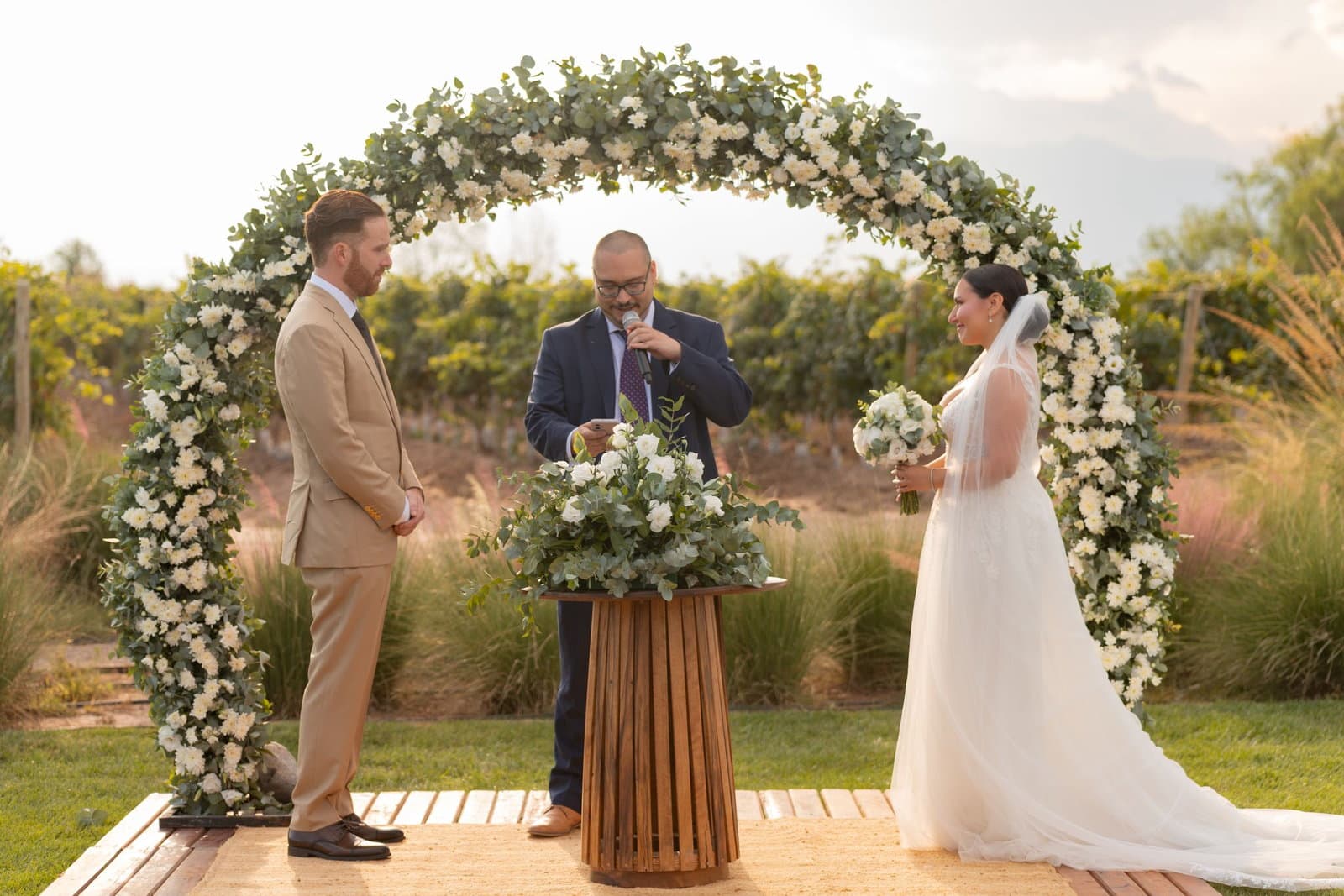
- Stand slightly off center so the photographer gets the couple's faces rather than your shoulder
- When you say "you may kiss", step back and get out of the frame
- Speak about twenty percent slower than feels natural, and pause after the lines that matter
If the day's broader choreography is still unsettled, our wedding day timeline template lays out a realistic run of show, and who does what on the wedding day covers how the rest of the party's jobs fit around the ceremony.
Step Seven: Sign the License, Then File It
The ceremony is the memorable part. This is the part that counts.
Immediately after the ceremony, somewhere quiet, complete the license with the couple and any required witnesses. Use the full legal names on the document, write legibly, and do not guess at any field. Most clerks will not accept correction fluid or crossed out entries, and a spoiled license usually means applying for a replacement.
Then file it. Return deadlines commonly run somewhere between a few days and 30 days after the ceremony, with 10 days being a frequent figure, so treat it as a this week task rather than a this month task. Confirm with the clerk whether you mail it or deliver it, and whether certified mail is required.
Two last habits worth having. Photograph the completed license before it leaves your hands, front and back. And tell the couple to order a certified copy once it is recorded, because that, not the signed license, is the document they will need for a name change, a passport, or an insurance form.
What Usually Goes Wrong
Nobody checks the county rules until the last month. Registration deadlines and license validity windows are the only genuinely unrecoverable mistakes available to you. Make the call in the first month.
The script is too long. Guests are standing, or in the sun, or both. Twelve minutes is generous. Twenty is a commitment.
You cry and cannot read. This happens to roughly everyone. Pause, breathe, drink the water you brought, and keep going. Nobody has ever minded.
Common Questions
Is an online ordination legally valid?
In most of the United States, an officiant ordained through a recognized online ministry can legally solemnize a marriage, but the requirements vary by state and are administered county by county. A few jurisdictions have been notably strict. The only reliable answer is the one you get from the clerk's office issuing the license, and that call takes ten minutes.
How long before the wedding should I get ordained?
Three to six months out is comfortable, because it leaves room for a county registration requirement or a document request. If the wedding is sooner, ordain yourself this week and call the clerk the same day.
Do we need witnesses?
It depends on the state. Many require one or two who sign the license alongside you, and plenty require none. Ask the clerk, then tell the couple early so they can choose people rather than recruit them at the reception.
Who files the marriage license?
Usually the officiant, and usually within a short window after the ceremony. Confirm the responsible party and the deadline with the clerk, do it in the first few days, and photograph the document before you send it.
The Short Version
Get ordained this week. Call the county clerk the same day and write down what they tell you. Spend ninety minutes with the couple asking real questions. Write twelve minutes, read it aloud with a timer, cut two. Bold the legal lines and read them exactly. Run the processional twice at the rehearsal. Print the script in large type, bring two pens, confirm who has the license. Sign it carefully, file it within days, photograph it first.
Everything on that list is small. Together they are the difference between a ceremony your friends remember warmly and a trip back to the clerk's office.
Keeping a ceremony's moving parts straight across readers, rehearsal timing, and a wedding party spread across inboxes? Nozari gives the couple and everyone helping one shared calendar and task list, so the rehearsal cues and the license deadline live somewhere other than your memory. See how it works.