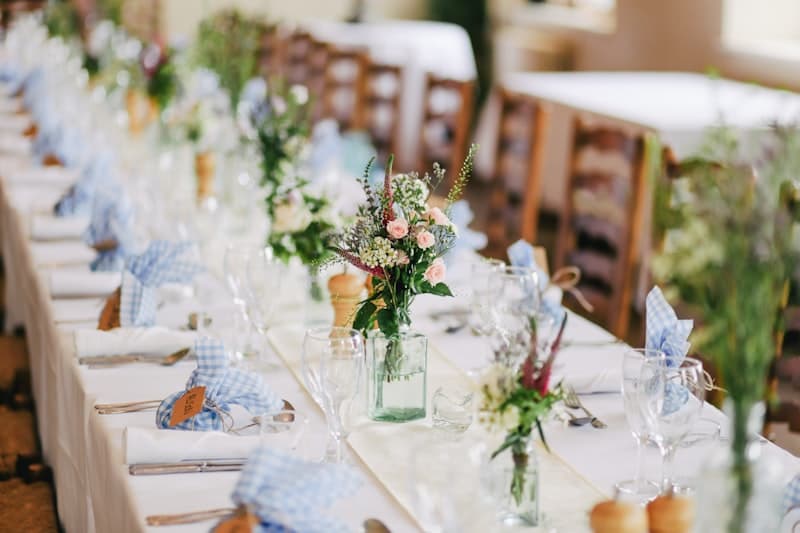
The rehearsal dinner is the event most couples spend the least time planning and then, afterward, describe as one of their favorite parts of the whole weekend.
That makes a certain sense. It's the one night where everyone who matters most is in the same room, nobody's on a schedule, and the couple isn't being pulled in fourteen directions. It's the wedding without the performance.
It also has more unwritten rules than almost any other wedding event — who hosts, who's invited, whether it's formal, who speaks — and very few people are handed clear answers.
Here's the practical version.
First, the Rehearsal Itself
Worth separating: there are two things happening, usually back to back.
The rehearsal is the functional walkthrough at the ceremony venue. Typically 30 to 60 minutes, the evening before the wedding, though it can be earlier in the day.
The rehearsal dinner is the meal afterward.
The rehearsal is short and genuinely useful. Its purpose is to answer the small logistical questions that otherwise become visible hesitation during the actual ceremony:
- Where does everyone stand, and in what order
- Who walks with whom, and at what pace
- When to walk — the cue is almost always musical, and hearing it once helps
- Where to look, where to hand off a bouquet, when to sit
- Who's handling the rings, and where they physically are until that moment
Whoever's running it — the officiant, a coordinator, or the venue — will walk the party through the processional twice, sometimes three times. That's it.
The single most common mistake is treating the rehearsal as optional for part of the party. If someone's walking in the processional, they should be at the rehearsal. A groomsman who skips it is the one visibly counting people and guessing when to move.
Two practical notes: run the rehearsal at the same time of day as the ceremony if you can, so the lighting and any sun position match. And bring the actual processional music, not a hummed approximation — cues are the whole point.
For how the party's roles fit together on the day itself, our who does what on the wedding day breakdown covers the full picture.
Who Hosts and Who Pays
Traditionally, the groom's family hosts and pays for the rehearsal dinner. This convention originated when the bride's family covered the wedding itself, and the rehearsal dinner was the other side's contribution.
Practically, it's whoever is willing and able, and the tradition has loosened considerably. Common arrangements now:
- One set of parents hosts, following the traditional split
- The couple hosts, particularly when they're paying for the wedding themselves
- Both families split it
- A combination — one family covers the venue, another covers drinks
The important part isn't which arrangement you pick. It's that the conversation happens early and explicitly, ideally at the same time you're discussing who's contributing what to the wedding overall. A rehearsal dinner that everyone assumed someone else was handling becomes a stressful surprise in month ten.
If you're navigating contribution conversations generally, our guide to splitting wedding costs with your party covers how to have them without them turning awkward.
Who's Invited
This is where most of the uncertainty lives. The baseline list:
Always invited:
- The couple
- The wedding party — all of them, plus their partners
- Immediate family on both sides — parents, siblings, and siblings' partners
- The officiant, and their partner
- Parents of any child attendants (flower girls, ring bearers), since they're supervising
Commonly invited:
- Grandparents
- Godparents, or anyone with a ceremony role like a reader
- Out-of-town guests who've traveled a long way
That last group is where lists expand fast. Inviting all out-of-town guests is a genuinely kind gesture — they've flown in and have nowhere to be that evening — but at a wedding where most guests are traveling, it can turn a 25-person dinner into a 90-person second reception.
If your guest list skews heavily out-of-town, a common solution is a rehearsal dinner for the core group followed by casual drinks that anyone in town is welcome to join. You get the intimate dinner and the inclusive gesture without doubling the catering bill. For a destination wedding, where nearly everyone has travelled, the wider version is closer to the norm than the exception.
Tracking who's invited to which event is exactly the kind of thing that sprawls across notes apps — our guest list management guide covers keeping the events straight alongside the main list.
Two rules worth holding:
Wedding party partners get invited, even ones you've never met. Excluding someone's spouse from the dinner and then seating them at the wedding is a slight people remember.
And anyone at the rehearsal dinner should be invited to the wedding. As with showers, the reverse isn't true — plenty of wedding guests aren't at the rehearsal — but inviting someone to the dinner and not the wedding doesn't work.
What It Costs
Highly variable, because format varies enormously. The realistic range runs from a backyard barbecue to a private dining room at a nice restaurant, and the per-head difference is substantial.
Cost drivers, roughly in order:
- Headcount — the single biggest lever, and the one most within your control
- Venue type — private dining rooms often carry a food-and-beverage minimum rather than a room fee
- Alcohol — open bar versus beer and wine versus cash bar is frequently the largest swing
- Day of week — a Friday private room costs more than a Thursday
- Formality — plated dinner service versus family style versus buffet
A useful planning benchmark: budget the rehearsal dinner at roughly 10–20% of your wedding reception cost. If it's coming in above that, the headcount is usually the reason, not the venue.
Choosing a Format
The rehearsal dinner works best when it's deliberately less formal than the wedding. It's the warm-up, not a second act.
Restaurant private room — the most common choice by a wide margin. No setup, no cleanup, predictable per-head cost, and someone else handles service. If there's a default, this is it.
Family home or backyard — warmest and most economical, most work for whoever's hosting. Best for smaller groups.
Brewery, winery, or casual venue — relaxed, usually flexible on format, often good value.
Something regional — a crab boil, a barbecue, a taco spread. Particularly good when guests have traveled, since it gives them something of the place.
What to avoid: replicating the wedding. A formal plated dinner with a full program the night before a formal plated dinner with a full program makes the wedding itself feel less special, and it exhausts everyone a day early.
One practical note that matters more than it sounds: pick somewhere people can actually hear each other. The entire value of this dinner is conversation among people who don't often share a room. A venue with hard surfaces and loud music defeats the point.
Toasts and the Program
This is the night for toasts — and it's genuinely better here than at the wedding, where the schedule is tight and the room is large.
Who typically speaks:
- The host — whoever's paying, usually a parent, opens and welcomes everyone
- The couple — thanking everyone for coming and traveling
- Parents from either or both sides
- Anyone who wants to — the maid of honor and best man usually save theirs for the wedding, which leaves room for people who won't otherwise get a moment
Keep it loose but bounded. The rehearsal dinner is where toasts run long, because it's relaxed and there's no coordinator moving things along. A gentle structure helps: let the host know they're opening, ask two or three people in advance if they'd like to speak, and have someone close it out.
A word of caution people appreciate afterward: the open-floor toast is charming right up until it isn't. If you're opening it to anyone, have the host frame it — "a few words, keep it kind" — and be ready to close it gracefully.
This is also a natural moment for wedding party gifts, if you're giving them. Most couples hand them out here rather than on the wedding morning, when everything is compressed. If you're the one organizing on either side, the maid of honor checklist and best man duties timeline both place the rehearsal dinner in the wider arc of the role.
A Realistic Timeline
4–6 months out — Settle who's hosting and roughly what the budget is. Pick the date, which is nearly always the evening before the wedding.
3–4 months out — Book the venue. Private rooms at good restaurants book further ahead than people expect, especially on Fridays in peak season.
2 months out — Finalize the guest list. Confirm the rehearsal time with your officiant and ceremony venue, since the dinner time depends on it.
6 weeks out — Send invitations. These can be considerably more casual than wedding invitations — email is entirely acceptable — but they should be a real invitation with a time and place, not a verbal mention.
2 weeks out — Confirm headcount with the venue. Plan the menu. Line up who's speaking.
1 week out — Confirm the rehearsal time with everyone walking in it, in writing. Give final numbers to the venue. Confirm any dietary restrictions.
The day of — Rehearsal first, dinner after, with enough gap that a rehearsal running long doesn't make everyone late.
Our wedding planning timeline places the rehearsal dinner alongside everything else in the final months, if you want the full sequence.
The Detail Everyone Forgets
Tell people the rehearsal time in writing, more than once.
This is the single most common rehearsal dinner failure, and it's entirely avoidable. The time gets mentioned in passing at a dress fitting in month four, changes slightly when the venue confirms, and then three people arrive an hour late on the actual evening.
The rehearsal time is a different time and often a different location from the dinner. Both need to be communicated clearly, in writing, to everyone walking in the ceremony — and re-confirmed the week of.
While you're at it, tell people the dress code. "Rehearsal dinner" means wildly different things to different people, and someone will otherwise arrive in a suit to a backyard barbecue or in jeans to a private dining room.
Ending the Night at a Reasonable Hour
The rehearsal dinner is the night before your wedding. That's easy to forget once everyone's relaxed, the toasts are flowing, and the people you love are all in one room.
Some practical guardrails that people are grateful for the next morning:
- Set an end time and mention it when you invite people
- Have a plan for after-drinks — if there's an informal continuation, make it clearly separate so nobody feels obliged
- The couple should leave first, which gives everyone else permission to wind down
- Keep an eye on the wedding party, who have jobs in the morning
Nobody regrets ending the rehearsal dinner at a sensible hour. A meaningful number of people regret the alternative.
Why It's Worth Doing Well
At the wedding itself, you will speak to most guests for roughly ninety seconds each. That's not a failure of hosting — it's the arithmetic of a hundred-plus people and a fixed number of hours.
The rehearsal dinner is the one evening where you actually get to sit with the people closest to you, without a schedule, before the day everyone's been building toward. Treated as an afterthought, it's a meal. Treated deliberately — right size, right room, enough time — it's frequently the part couples talk about most afterward.
Coordinating a rehearsal, a dinner, and a wedding across a party that's half out of town? Nozari keeps the schedule, locations, and who-needs-to-be-where in one place your whole wedding party can see — so nobody's asking what time the rehearsal is the night before. See how it works.

