Two mailings, two completely different jobs, and most of the confusion about them comes from treating them as the same announcement sent twice.
A save the date asks one thing: hold this day. An invitation asks a different thing: come, and tell us whether you are coming. The first one protects your guest list from everyone else's calendar. The second one collects your headcount.
Here is the timing for each, what belongs on them, and the single rule about save the dates that catches couples out every year.
The Timeline at a Glance
| Mailing | Standard wedding | Destination or holiday weekend |
|---|---|---|
| Save the date | 6 to 8 months before | 8 to 12 months before |
| Invitation | 6 to 8 weeks before | 10 to 12 weeks before |
| RSVP deadline | 3 to 4 weeks before | 5 to 6 weeks before |
| Final headcount to caterer | usually 7 to 14 days before | usually 7 to 14 days before |
Read that bottom row first, because it is the one that actually sets everything else. Your caterer or venue has a date by which they need a final number. Every other deadline on this page is derived from it, working backwards.
Save the Dates
What they are for
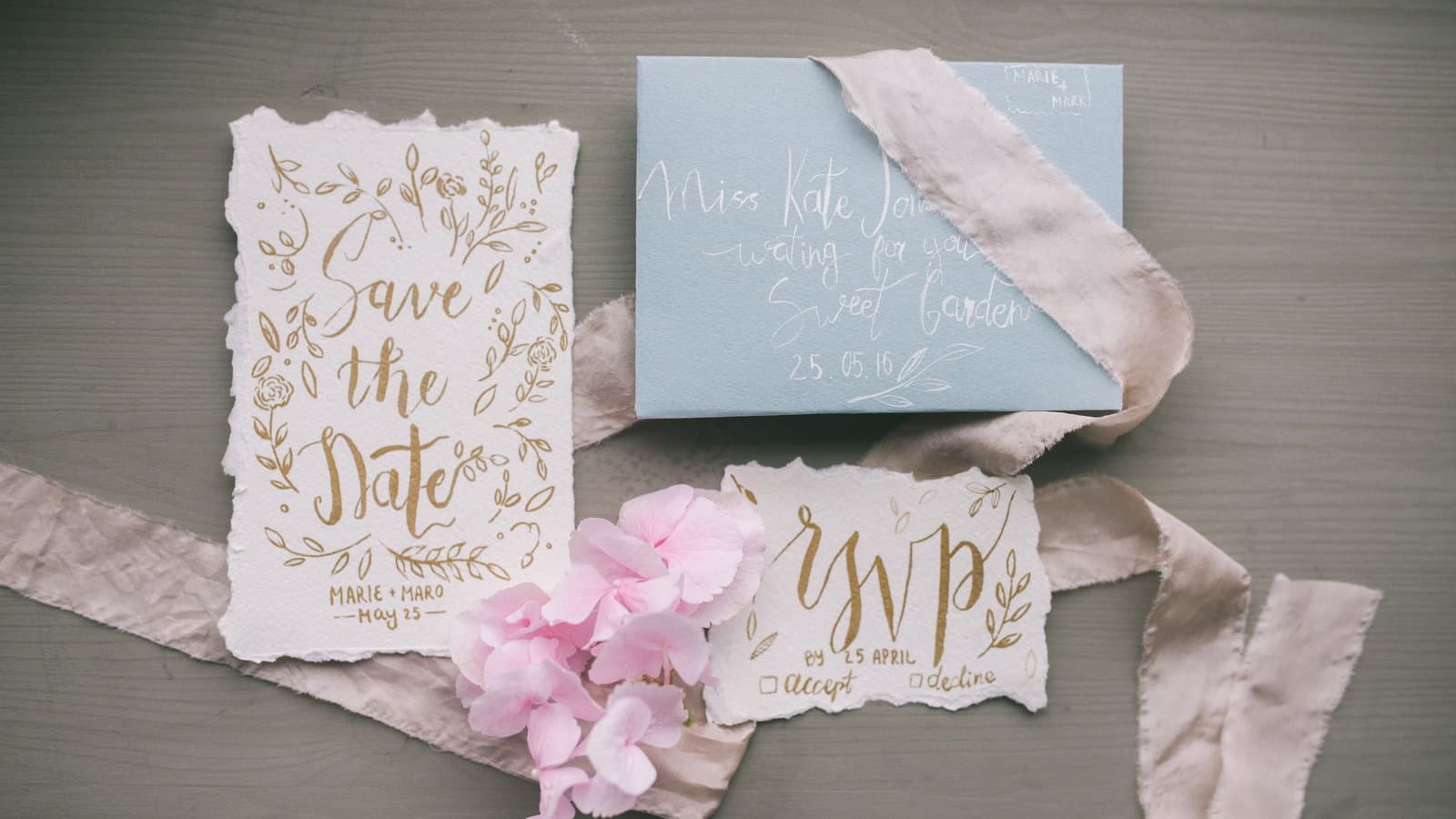
A save the date does not invite anyone. It tells people who are definitely being invited to keep a day clear before something else claims it. That is the whole function, and it matters most for guests who need to book travel, request time off, or arrange childcare.
When to send them
Six to eight months out for a standard wedding. Earlier than eight months and people file it somewhere and forget; later than six and the travelers have already made other plans.
Eight to twelve months out for a destination wedding, or any wedding that requires flights for a large share of the guest list. Our guide to what to tell destination wedding guests and when breaks down the full reminder schedule for those, including the passport nudge that belongs in the very first message.
Nine to twelve months out if your wedding falls on a holiday weekend, over a long weekend, or in a town with one hotel and a festival that weekend.
If your date is less than four months away, skip save the dates entirely and send the invitations. Two mailings three weeks apart is a waste of postage and slightly confusing.
What goes on one
Keep it short. Five lines is plenty.
- Both names
- The date
- The city and state, not the venue address
- "Invitation to follow"
- Your wedding website, if you have one
What does not go on one
- The ceremony time, which will probably change
- The venue address or reception details, which belong on the invitation
- Dress code
- Any RSVP request, because there is nothing to respond to yet
- Registry information, ever, on either mailing
The one rule that matters
Never send a save the date to anyone you might not invite. A save the date is a commitment. Once somebody has one on their fridge, cutting them from the final list is a genuinely painful conversation, and it happens every year to couples who sent save the dates before their guest list was settled.
Which means the guest list has to be close to final before the first mailing goes out, including the capacity math and the plus one policy. That is the real reason save the dates feel stressful: they force a decision three months earlier than couples expect. Our guide to wedding guest list management walks through drafting, trimming to your venue's real capacity, and handling the plus one question, which is the work that has to happen before anything gets printed.
If you are planning a B list, send save the dates only to the A list and keep the second tier for the invitation round. It is less elegant than pretending you do not have tiers, and it is what nearly everyone actually does.
Invitations
When to send them
Six to eight weeks before the wedding is the standard, and it is standard for a good reason: far enough out that people can plan, close enough that they can actually answer. Earlier than eight weeks and the RSVPs sit in a drawer. Later than six and you are chasing responses while also finalizing a seating chart.
Ten to twelve weeks for a destination wedding, or if a meaningful number of guests are flying.
Note that "send" means arriving in people's hands, so mail them a few days ahead of that window rather than on its last day.
What goes on the invitation
- Who is hosting, if the wording names hosts, which traditionally means whoever is paying but increasingly just means the couple
- Both names, in whatever form you prefer
- The request line, as in "request the pleasure of your company" or anything plainer you like better
- The date and the start time
- The venue name and full address
- A reception line, either "reception to follow" or a separate line with a different venue and time
- Dress code, optional but genuinely useful, and the thing guests ask about most
- How and by when to respond
The enclosures
Most invitation suites include two or three extra pieces:
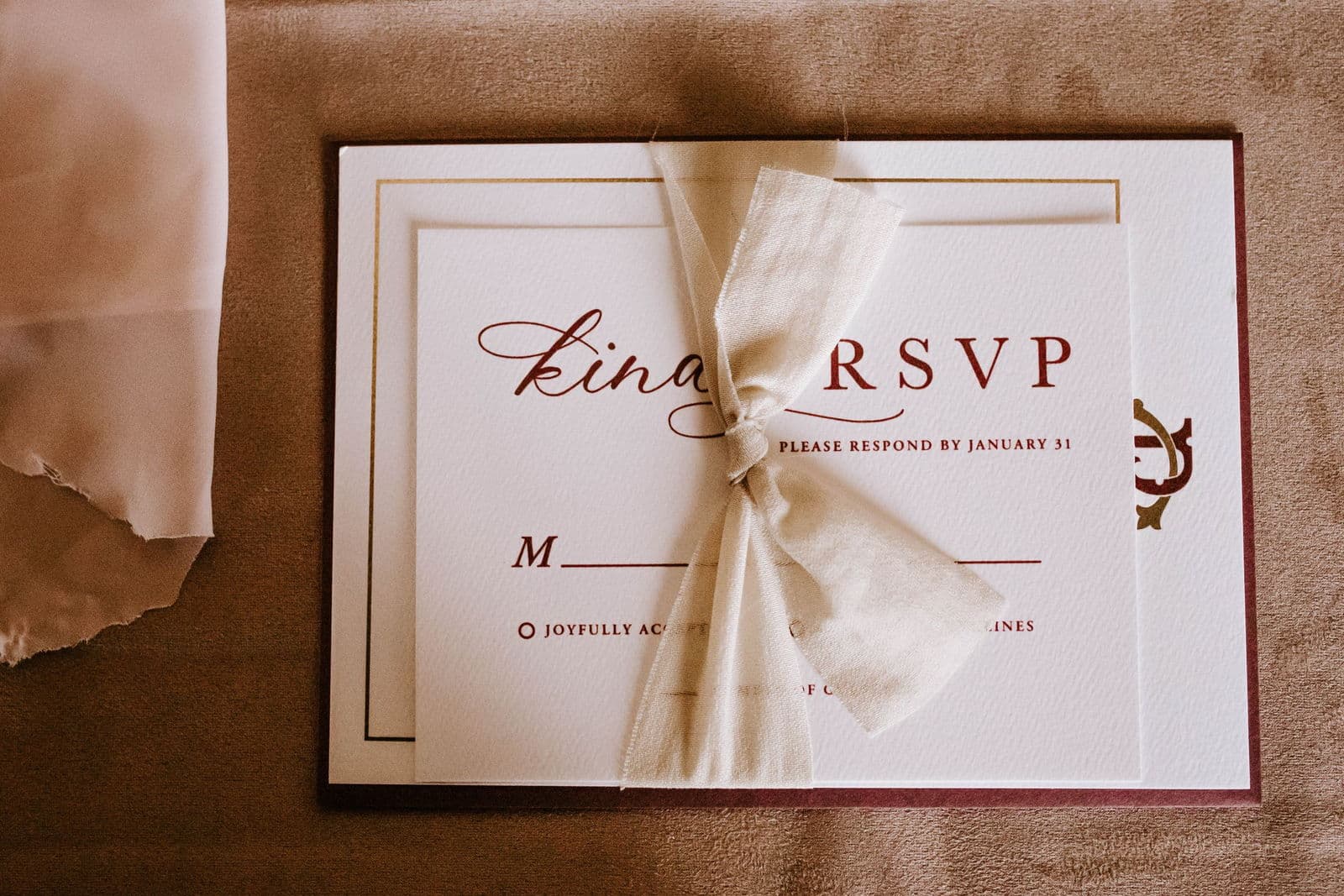
The response card or RSVP link. A stamped, addressed reply card if you are doing paper. A short URL or QR code if you are doing digital. Include a line for the guest's name, an accept or decline, and meal choices if the caterer needs them. Number the back of each reply card lightly in pencil against your guest list, because somebody will return a card with no name on it. Somebody always does.
A details card. Accommodation and room block codes, transport and parking, timing for any additional events, and the website. This is where everything that does not fit on the invitation goes.
A map or directions, for rural venues or anywhere a phone's navigation gets confused. Still worth doing, and guests appreciate it more than you would expect.
Setting the RSVP deadline
Work backwards from the caterer, not forwards from the invitation.
- Ask your caterer or venue for the final headcount date. It is usually 7 to 14 days before the wedding.
- Add about two weeks of buffer for chasing non responders, building the seating chart, and giving final numbers to the venue and the calligrapher.
- That is your RSVP deadline, which typically lands 3 to 4 weeks before the wedding.
Set it on a specific date, not a vague "by the end of the month", and print it in a size people can read.
Email Versus Paper
Both work. Most couples now land in the same place, and it is the sensible one.
Digital save the dates are completely normal. They cost nothing, they arrive instantly, they are easy to resend to the three people whose address you got wrong, and nobody keeps a save the date forever anyway. Email or a messaging app is fine. If you want something that feels considered, a well designed digital card beats a cheap printed one.
Paper invitations are still the default for the invitation itself, and the reasons are practical as much as sentimental. They are harder to ignore than an email, they handle older guests and guests without reliable email better, and they are the piece people actually keep.
The hybrid most couples use: digital save the dates, paper invitations, digital RSVPs. That combination keeps the one mailing that matters tangible, removes the cost of the one that does not, and makes the responses land somewhere countable instead of in a stack of cards on a sideboard.
A few cost and logistics notes if you are printing:
- Printed save the dates commonly run $1 to $3 each; full invitation suites $3 to $8 each, more for letterpress or anything with a wax seal
- Order 10 to 15 percent extra, for addressing mistakes, late additions, and one for your own album. Reprinting a short run costs almost as much as the original
- Take a fully assembled sample to the post office and have it weighed before you buy any stamps. Square envelopes, thick card stock, and anything over a standard size can require extra postage, and finding that out after you have bought 120 stamps is an annoying afternoon
- Ask about hand cancelling if your envelopes are delicate or the stamps are decorative
- Address them by hand or have them printed, but either way, address them from one clean list rather than from three
What Usually Goes Wrong
Save the dates go out before the guest list is final. The most common and least fixable mistake on this page.
The invitation arrives too late to answer comfortably. Four weeks out means a scramble. Six to eight is the window.
The RSVP deadline is set arbitrarily. It should come from the caterer's headcount date, minus a buffer, and nothing else.
Registry details appear on the invitation. They belong on the website, and only there.
Nobody includes a dress code, and then every guest texts one person to ask.
Addresses are collected twice, from different places. Collect them once, in one list, and keep it.
For how both mailings fit into the broader run of the engagement, our month by month wedding planning timeline places them alongside the vendor and venue deadlines they actually interact with.
Common Questions
How far in advance do you send save the dates?
Six to eight months before the wedding for a standard wedding, and eight to twelve months for a destination wedding or a holiday weekend. If the wedding is less than four months away, skip them and send invitations instead.
How far in advance do you send wedding invitations?
Six to eight weeks before the wedding, or ten to twelve weeks for a destination wedding. Mail them a few days before that window opens so they arrive inside it.
Does everyone who gets a save the date have to get an invitation?
Yes. Treat a save the date as a binding commitment, because that is how guests read it. This is why the guest list needs to be effectively final before the first mailing, and why a B list should only ever be invited in the invitation round.
Can you send save the dates by email?
Yes, and plenty of couples do. Digital save the dates are now unremarkable, cost nothing, and are easy to correct and resend. Paper remains the common choice for the invitation itself, which is the piece guests keep and the one you least want overlooked.
What should the RSVP deadline be?
Three to four weeks before the wedding for most weddings, set by working backwards from your caterer's final headcount date and adding roughly two weeks of buffer for chasing replies and building the seating chart.
The Short Version
Save the dates at six to eight months, eight to twelve for a destination. Names, date, city, "invitation to follow", website, nothing else. Send them only to people you are certain about.
Invitations at six to eight weeks, ten to twelve for a destination, with full details, a dress code, and an RSVP deadline three to four weeks out that you derived from the caterer's headcount date.
Digital for the first mailing, paper for the second, one address list for both.
Tired of keeping your guest list in one file, addresses in another, and RSVPs in a text thread? Nozari keeps guests, addresses, responses, plus one names, and meal preferences in one place, so your count is always current and nobody is re typing replies. See how it works.