The wedding party list is one of the first things a newly engaged couple writes and one of the last things they finish. It starts as four names, grows to nine over a weekend, drops back to six after a conversation about what it costs, and then somebody's sister gets added and the whole thing reopens.
The number itself is not the hard part. The hard part is that every name on that list is a relationship, and the list is read by people who are not on it.
So here are the usual sizes, the real cost of each extra person, what actually changes as the group grows, and a method for deciding that does not depend on anybody's feelings about anybody else.
The Usual Sizes
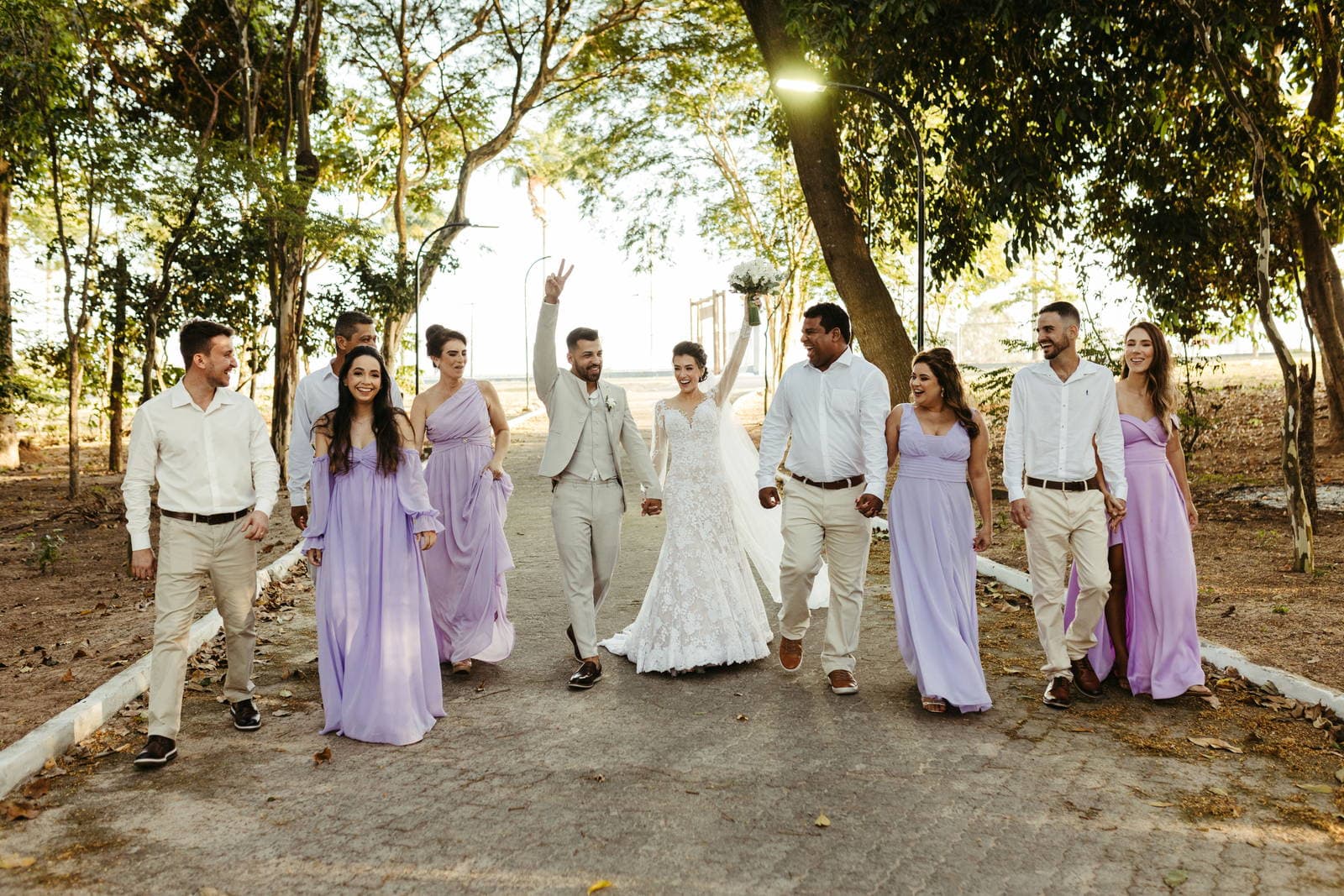
Most American weddings land between four and six attendants on each side, which means a total party of eight to twelve. Smaller weddings often have one or two on each side, and plenty have none at all. Large weddings sometimes run to eight or ten a side, which is a different exercise and is covered below.
| Wedding size | Common party size |
|---|---|
| Under 50 guests | 0 to 2 per side |
| 50 to 100 guests | 2 to 4 per side |
| 100 to 200 guests | 4 to 6 per side |
| 200 or more | 5 to 8 per side |
Those are rough correlations, not rules. A couple with 60 guests and seven lifelong friends can have seven, and a couple with 300 guests can walk in with one person each. The guest count matters mainly because it changes how the group looks at the front, and because large weddings tend to involve larger families with more people who expect to be asked.
One honor attendant per side is the norm: a maid or matron of honor, a best man, or an honor attendant with no traditional title. Two is increasingly common and causes no problems as long as you have told them both what each of them is responsible for.
Do the Sides Have to Match?
No. They have not had to for a long time, and photographers stopped needing them to roughly when they stopped lining everyone up in strict pairs.
Uneven sides are so common now that nobody at the wedding will notice unless the gap is dramatic. Four and six is invisible. Two and eight reads a little, and even then the usual fix is staging rather than recruitment.
How uneven sides are normally handled:
- Walk in pairs where there are pairs, then have the extras walk together or alone. Thirty seconds of thought at the rehearsal.
- Stand in an uneven line and let the photographer arrange it. They do this constantly.
- Have someone escort two people, one on each arm, which looks deliberate because it is.
What not to do is add a person to even out a number. People can tell when they were a solution to a geometry problem, and the person who was asked last usually works it out.
Mixed-gender parties solve this on their own, and they are now entirely unremarkable. A bride with two close male friends standing on her side, or a groom with his sister as his best person, is a normal wedding in 2026 and requires no explanation to anybody.
What Each Attendant Actually Costs You
This is the part couples underestimate, because the per-person costs are small and there are a lot of them.
For the couple, each additional attendant usually adds somewhere between $150 and $400, depending on what you choose to cover. The pieces:
| Item | Usual cost per attendant |
|---|---|
| Bouquet or boutonniere | $40 to $90 |
| Thank you gift | $30 to $75 |
| Rehearsal dinner seat | $40 to $100 |
| Hair and makeup, if you cover it | $100 to $200 |
| Transport, if you cover it | $15 to $40 |
| Getting-ready space and food | $10 to $30 |
Eight attendants instead of four is therefore commonly $600 to $1,600 of additional spend, before anything optional. That is a real line in a budget and it is worth knowing before the list gets long rather than after.
There is a second cost, and it falls on them. A bridesmaid or groomsman typically spends well over a thousand dollars across the year, which our line by line of bridesmaid costs breaks down. Asking someone is asking them to spend that. It does not mean asking fewer people, but it does mean the number should be a decision rather than a drift.
What Changes as the Group Gets Bigger
Four people behave differently from twelve, and the difference is not linear.
Up to about four a side, everyone knows what is happening because everyone is in every conversation. Nobody needs a system.
Around six a side, you cross a line. The group chat starts firing during work hours, people mute it, and decisions start getting made by whoever happened to be online. This is where a couple usually becomes the router for information between people who should be talking to each other. Our piece on why wedding party group chats fall apart is about exactly this threshold.
Past about eight a side, the group stops behaving like a group and becomes an audience. Diffusion of responsibility sets in properly: "someone should book the restaurant" is read by eleven people and acted on by none. Large parties work, but only when tasks are assigned to named individuals rather than announced to everyone, which is the whole premise of our wedding party coordination guide.
Around two dozen in total is where most couples find the practical ceiling, and it is worth saying why rather than treating it as a number. At that size the getting-ready room no longer fits, the processional takes real minutes, the group photograph needs a wider lens and a flatter patch of ground, the thank you gifts become a four figure line, and no single conversation can include everybody. None of that is impossible. All of it needs deciding in advance rather than on the morning.
How to Decide
A method that works better than staring at a list.
1. Write down everyone you would be sad not to have standing there. No editing, no counting. Just the names.
2. Mark the ones who would be in it for the next twenty years. Not the ones you see most this year. The ones you expect to still know well at the next wedding, and the one after that. This is the single most useful filter on the page, because wedding parties are chosen in a specific season of life and looked at in photographs for decades.
3. Mark anyone being considered out of obligation. A future sibling-in-law, a friend who put you in theirs, a cousin your mother raised. Keep them if you want them. But know which names are on the list for that reason, because they are the ones you will quietly resent spending $300 on.
4. Count what is left, then decide what you can cover. Multiply by the per-person figures above. If the total is uncomfortable, the honest options are a smaller party or covering less, and both are completely normal.
5. Check the practical constraints. Where everyone gets ready, how many fit in the photograph, whether the rehearsal dinner venue seats that many. These are boring and they are the ones that bite on the day.
6. Ask in a deliberate order, honor attendants first, and tell each person the real cost picture when you ask. Our guide to asking someone to be in your wedding party covers the wording, including how to name the number without making it awkward.
Other Ways to Include People
The best answer to "I have eleven people and room for six" is usually not a bigger party. There are real roles, and people take them seriously when they are offered properly rather than as a consolation.
- Ushers, who seat guests and are genuinely busy for the half hour that matters most.
- A reader, which is a visible role in the ceremony itself and takes two minutes of standing at the front.
- The MC, which is one of the most important jobs of the day and one almost nobody volunteers for.
- Day-of coordinator, the person who holds the timeline and answers vendor questions so the couple does not have to.
- Someone who gives a toast without being in the party at all, which is unremarkable and often the best speech of the night.
Offer any of these as what they are, which is a real job with a real moment, and most people would rather have one of them than stand in a line for an hour.
Common Questions
How many bridesmaids and groomsmen is normal?
Four to six on each side is the common middle at American weddings, for a total party of eight to twelve. Smaller weddings often have one or two each, and some couples have none. Larger weddings run to eight or more a side, which works but needs tasks assigned to named people rather than announced to the group.
Do the bride's side and the groom's side need the same number?
No. Uneven sides are completely standard now and photographers handle them without being asked. Walk the pairs you have, have the extras walk together, and let the line be uneven. Adding a person to even out a number is the one thing to avoid, because people can usually tell.
How much does each extra bridesmaid or groomsman cost the couple?
Usually $150 to $400 each, depending on what you cover. Flowers run $40 to $90, a thank you gift $30 to $75, a rehearsal dinner seat $40 to $100, and hair and makeup another $100 to $200 if you are paying for it. Going from four attendants to eight commonly adds $600 to $1,600.
What is the maximum size for a wedding party?
There is no fixed limit, but most couples find the practical ceiling around two dozen people in total. Past that, the getting-ready space, the group photograph, the processional and the gift budget all need planning in advance, and no single conversation can include everyone.
Can you have a mixed-gender wedding party?
Yes, and it is entirely normal in 2026. A bride with male friends standing on her side, or a groom with his sister as his best person, needs no explanation to anyone. Mixed parties also solve the uneven-sides question on their own, because the strict pairing convention stops applying.
The Short Version
Four to six a side is the common middle, eight to twelve in total. The sides do not need to match and nobody notices when they do not. Each attendant usually costs you $150 to $400 and costs them well over a thousand, so the number should be chosen rather than allowed to grow. Around six a side is where you start needing a system, and around two dozen in total is where the practical ceiling sits.
Pick the people who will still be in your life at the next wedding, and give everyone else a real job instead.
Eleven people, four events and a list of who owes what? Nozari gives every member of the wedding party their own login, their own tasks, and one shared calendar. See how it works.